


The UK’s Most Photographed Beaches
and how to capture them with your camera

From the golden sandbanks of Dorset to the dramatic cliffs of Whitley Bay, the UK is home to plenty of beautiful beaches. But which ones are the most photogenic and worth a spot on your summer travel list?
To find out, we’ve pulled together a list of the top 15 most photographed beaches in the UK based on the number of Instagram hashtags attributed to each location to give you some summer inspiration.
Plus, we’ve got expert tips from Lizzie James, Product Specialist here at Jessops, to help you get the best beach photography using your digital camera.
Contents
What are the UK’s most photographed beaches?
How to take the perfect landscape image of the beach with your digital camera
What are the UK’s most photographed beaches?
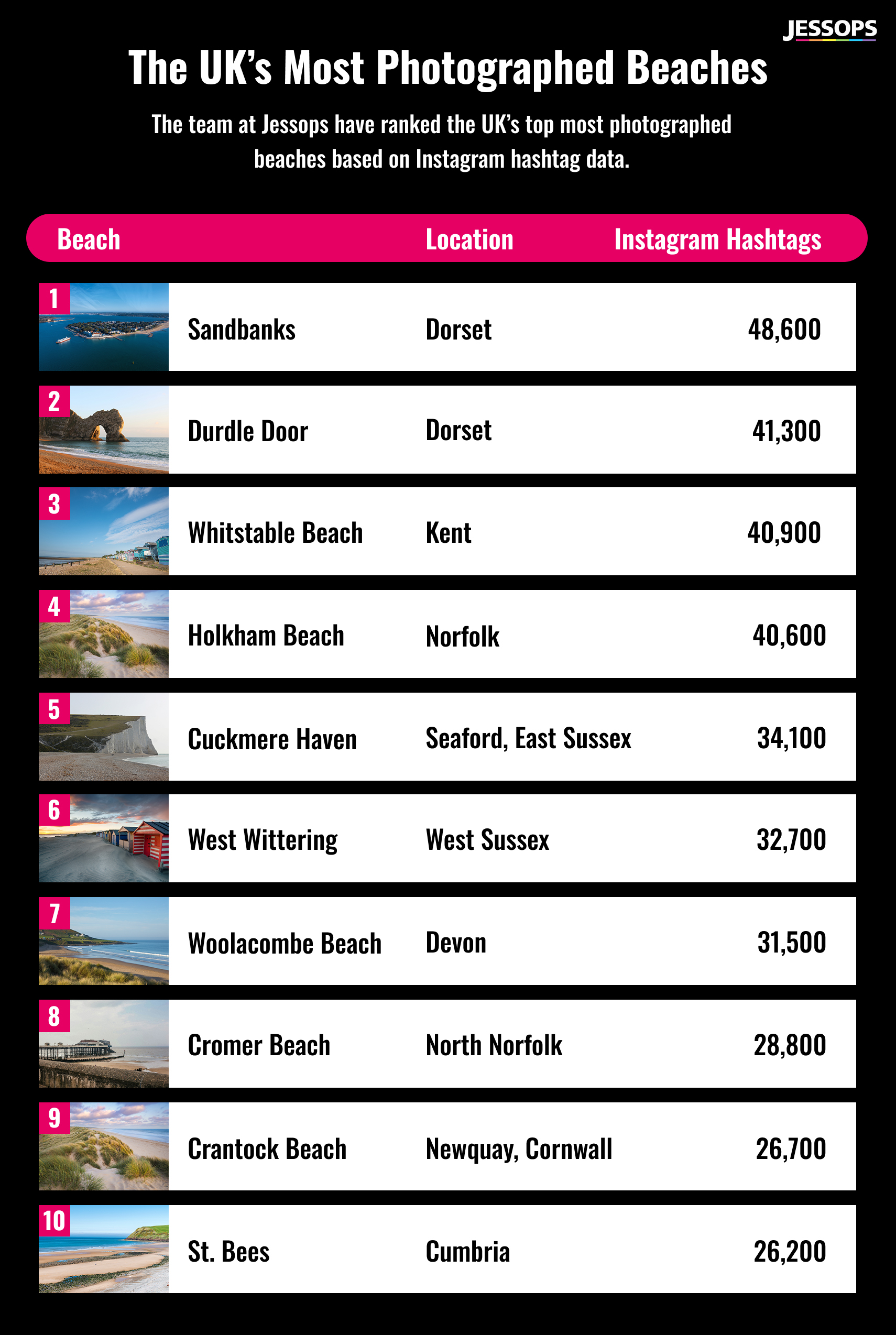
Learn the very best beaches in the UK for photography! Whether you’re after dramatic cliffs, golden sand, or unique coastal landmarks, these seaside spots are made to be captured.
“Most of the UK’s most photographed beaches are clustered in the south,” says Lizzie. “But you definitely shouldn’t be overlooking the north! There are some real gems up there too, like the dramatic cliffs of Whitley Bay and the rugged beauty of St Bees in Cumbria.”
1. Sandbanks, Dorset
If you're looking for picture-perfect beach days, Sandbanks ticks every box — and the nearly 50,000 Instagram hashtags agree. With golden sand, clear blue waters and sweeping views over to the Jurassic Coast, it's no surprise this small but mighty stretch of coastline is one of the UK's favourite seaside escapes.
Set on a tiny peninsula where Poole Harbour meets the English Channel, Sandbanks has that rare combination of natural beauty and family-friendly fun. Think calm, shallow waves (ideal for paddling or paddleboarding) and plenty to do — from mini golf to water sports that'll keep kids and grown-ups entertained all day. And if the views feel a little bit cinematic, you're not imagining it — Sandbanks has been featured in films, including Dunkirk and Walking on the Moon, thanks to those big skies and sweeping coastal backdrops.

Plus, it's Blue Flag certified, meaning it's one of the cleanest, safest, and best-maintained beaches in the country.
Bringing a GoPro or action camera? The calm, shallow waters are ideal for underwater clips or paddleboard shots with crystal-clear visibility. A drone also works brilliantly here — the contrast between golden sand, turquoise water, and the curving peninsula makes for striking aerial shots. Just remember to follow local drone regulations, particularly around residential and protected areas.
To learn more, read our guide on choosing the right drone.
2. Durdle Door, Jurassic Coast, Dorset
Taking the second spot on the UK's most photographed beaches list is another Dorset gem — Durdle Door. The iconic limestone arch, shaped by the sea over thousands of years, makes it one of the most iconic coastal landmarks in the country. It's a must-visit whether you're there to shoot or simply take in the coastal views on foot!
Even the name has a story — 'Durdle' comes from an old word meaning 'to pierce,' which fits perfectly when you see how the sea's carved right through the rock.
"Golden hour here is pure magic," says Lizzie. "The soft light pouring through the arch adds depth, drama, and that warm coastal glow that really brings your shots to life."

"A good tip is to head there during the winter solstice, it’s one of the few times the sun rises in perfect alignment with the archway. It’s become a bit of a bucket-list shot for landscape photographers, and for good reason!"
3. Whitstable Beach, Kent
In third place is Whitstable Beach in Kent — proof that you don’t need golden sand to make a seaside spot special. What it lacks in sand, it more than makes up for in charm. Think colourful beach huts that are made for photography and fishing boats pulled up on the shingle.

4. Holkham Beach, Norfolk
Coming in at number four on the UK’s most photographed beaches list is Holkham Beach in Norfolk. It’s one of the best sandy beaches in the UK! This vast, open stretch of coastline seems to go on forever, especially when the tide’s out, and the water retreats almost to the horizon.
Film fans might recognise it from the closing scene of Shakespeare in Love, where Gwyneth Paltrow walks across the sand — a moment that captures just how cinematic this place really is!
Framed by windswept dunes and a peaceful pine forest, Holkham has a wild, untouched feel that makes it perfect for wide-angle landscapes and minimalist shots.

It’s also a dream location for nature lovers and wildlife photographers. The beach is part of the Holkham National Nature Reserve, attracting all kinds of birdlife, from wintering flocks to nesting Little Terns and Oystercatchers.
5. Cuckmere Haven Beach, Seaford, East Sussex
Rounding out the top five is Cuckmere Haven Beach in East Sussex. It's a dramatic, pebbled stretch that's set against the towering white chalk cliffs of the Seven Sisters. This beach is one of the most striking coastal scenes in the UK, and an absolute favourite for photographers.
Lizzie says: “Cuckmere Haven is ideal for capturing the full sweep of the Seven Sisters cliffs. At low tide, you can get right down on the beach to shoot from below, which adds scale and drama to your shots. Try using a wide-angle camera lens to include both the cliffs and the shoreline, and aim for early morning or late afternoon light to bring out the textures.”

The dramatic setting has also caught the eye of filmmakers, with scenes from Harry Potter and the Goblet of Fire and Robin Hood shot here.
6. West Wittering Beach, West Sussex
West Wittering in West Sussex is a top spot for photographers who love sandy beaches and vibrant colours. The wide sand dunes provide a natural frame that’s perfect for creating depth in your shots, while the colourful wooden beach huts add character to your compositions.
If you’re into action shots, you’re in luck! When the conditions are right, you’ll see surfers, windsurfers, and kite surfers out on the water. It’s great to capture, but just be mindful to keep your distance and respect the surfers’ space. To learn more, read our photography etiquette guide.

7. Woolacombe Beach, Devon
Woolacombe Sands in Devon is a dream for photographers who like a bit of everything. With three miles of golden sand, clear blue waters, and busy spots for kayaking, swimming, and surfing, there’s always something going on to capture.
The long, open beach is perfect for wide-angle shots, especially at sunrise or sunset when the light stretches right across the sand.

8. Cromer Beach, North Norfolk
Cromer Beach in North Norfolk blends natural beauty with classic seaside charm. Framed by steep chalk cliffs and beautiful Victorian buildings, it’s a spot that feels timeless — perfect for a mix of landscape and street-style photography.
The promenade on the beach adds something a little different to your shots, especially in the summer months when it’s bustling with people. The view from the town above gives you a great vantage point for wider scenic frames.
Don’t miss the local fishing boats and crab pots dotted along the shore! Cromer is famous for its crabbing, and it’s a nice way to capture a slice of local life.

9. Crantock Beach, Newquay, Cornwall
Tucked just outside of Newquay, Crantock Beach feels like a quieter corner of Cornwall. It sits at the mouth of the Gannel Estuary, where the river meets the sea, creating peaceful reflections and plenty of interest for landscape photographers.
This beach is a haven for wildlife and colour, especially in early summer when wildflowers blanket the nearby slopes around the headland at Pentire Point West.
If you’re there at low tide, keep an eye out for the rock carvings hidden inside the caves at the southern end of the beach. They’ve been etched into the stone for over a century!

10. St. Bees Beach, Cumbria
St Bees Beach in Cumbria offers something a little different from your typical coastal photo spot. This mile-long stretch is a shingle bank that slopes down to golden sand, with red sandstone cliffs adding a dramatic edge to your shots.
There’s a wide promenade at the northern end, and if you head up to St Bees Head, you’ll be rewarded with sweeping views and a chance to photograph seabirds like guillemots and kittiwakes.
Lizzie says: “A zoom lens is a great idea if you want to photograph the birds. It lets you capture all the movement and detail of the seabirds without getting too close or disturbing them.”

11. Filey Brigg, North Yorkshire
Just missing out on our top 10, but still well worth a visit, Filey Brigg Beach in North Yorkshire is a hidden gem.
This dramatic stretch sits beneath steep cliffs and is framed by the natural promontory of Filey Brigg — a long, narrow rocky outcrop that juts out into the sea. At low tide, it reveals fascinating rock formations, tidal pools, and marine life, making it ideal for detail shots and coastal textures. It’s actually a site of geological importance, known for its exposed Jurassic rock layers and rich fossil history.
You’ve got layers to play with here: cliffs, beach, and the sweeping curve of the bay — all great for wide-angle compositions.

12. Whitley Bay, Tyneside
Whitley Bay Beach is another stunning spot on the coast. In fact, it's a Blue Flag beach, which means it meets high standards for water quality, safety, and environmental management.
This golden-sand stretch runs from Whitley Bay North right up to the iconic St Mary's Lighthouse, making it a fantastic place for photographers. The lighthouse stands out beautifully against the sea and sky, especially during sunrise and sunset when the light is at its best.
If you're visiting in the summer, don't miss the annual sandcastle competition! It's a great chance to capture some local community spirit.

13. Southwold Beach, Suffolk
Southwold Beach in Suffolk is everything you’d want from a classic British seaside day out — and then some. With its colourful beach huts, traditional promenade, and the much-loved Edwardian pier, it’s got plenty of charm (and photo opportunities) at every turn.
Awarded Blue Flag and Seaside Award status in 2025, it’s not just good-looking. It’s clean, safe, and well cared for, too. If you’re into capturing a bit of nostalgic coastal character, this stretch is a must.

14. Whitesands Beach, Pembrokeshire, Wales
Whitesands Beach in Pembrokeshire is one of Wales’s best-loved beaches. Backed by rolling green hills and overlooked by the dramatic peak of Carn Llidi, this sandy stretch is perfect for landscape shots.
It also happens to be one of the best surfing beaches in the UK, so there’s usually plenty of action to capture out on the water, whether it’s waves crashing, surfers carving through them, or the sun setting behind the headland.
Wildlife is a big draw too. Keep an eye out for seabirds, seals, and even porpoises just offshore.

15. Blackpool Sands, Devon
Blackpool Sands in Devon (not to be confused with Blackpool up north!) is a beautifully sheltered bay backed by lush pine trees and hills.
This Blue Flag-awarded, crescent-shaped beach has a Mediterranean feel, with turquoise waters and fine shingle that’s perfect for peaceful landscape shots.

How to take the perfect landscape image of the beach with your digital camera
Lizzie James, Product Specalist at Jessops, has rounded up her top 6 tips to help you get into beach photography and take stunning landscape shots.
1. Work with the sun
Lizzie suggests: “If you’re visiting on a bright day, try shooting in the early morning or late afternoon when the sun is lower in the sky. This is known as golden hour, and for good reason. The light is softer and warmer, which helps add depth and glow to your shots.”
Sunlight reflecting off the water, wet sand, or shiny pebbles can cause glare that flattens your image or creates unwanted haze. But if you do want to shoot midday, try adjusting your angle slightly or use a lens hood to reduce flare.”
“A circular polarising filter is also a game-changer. It cuts through reflections and boosts contrast in the sky and sea.”
2. Don’t forget the little details
“Sure, the beach makes for a great wide shot,” says Lizzie. “But the images that stand out most to me are the ones that capture the quieter moments — paddleboards resting on the sand, swimmers dotted across the water, or even a coastal cafe dishing up lunch. These kinds of shots add character and help tell the full story of your visit.”
“The small details are also where macro photography really comes into its own. It lets you get in close and focus on the finer textures, like the shimmer of sea glass, grains of sand on a towel, or the weathered surface of a shell.”
To learn more, read our beginner’s guide to macro photography.
3. Have a few lenses in your kit
Lizzie explains: “If you’ve got the option, pack a mix of lenses to give yourself flexibility. A wide-angle lens is brilliant for capturing the full scale of the beach. A telephoto zoom helps you get closer to action or wildlife without disturbing it. And something like a 50mm or a macro lens is perfect for picking out interesting textures and patterns.”
Having a few different lenses means you’re ready for whatever the coast throws your way.
Read our guide to camera lenses to find out more about the various types.
4. Work with the weather
"You don’t need perfect blue skies for great photos,” says Lizzie. “Overcast days are amazing for soft, even light, and windy conditions can add loads of atmosphere. You just have to lean into it. I like to use whatever the weather throws at me to bring movement or mood into the shot."
5. Keep your horizon straight
“Keeping your horizon level is one of the simplest ways to instantly improve your beach photos,” suggests Lizzie. “Especially when you’re shooting wide seascapes. A tilted horizon can be distracting and throw off the whole composition, unless you’re going for a creative angle on purpose.”
“In general, a straight horizon helps keep the scene balanced and naturally pleasing to the eye, and most digital cameras have a built-in grid to help with this. The grid places horizontal and vertical lines on your screen, so you can line up the horizon with one of the horizontal guides. Some cameras also have a digital level that acts like a spirit level, showing a line or marker that turns green or aligns when your shot is perfectly straight.”
6. Play around with shutter speed
Shutter speed is a camera setting that plays a big role in how your beach photos feel. Lizzie explains: “A slower shutter speed — anything from 1/10 of a second to several seconds — can create a beautiful sense of motion. It’s ideal for capturing the movement of waves.”
“To get the best results with slow shutter speeds, especially in bright conditions, you’ll usually need a tripod to keep the camera steady and prevent blur.”
“A Neutral Density (ND) filter can also come in handy. It reduces the amount of light hitting your sensor, making it easier to shoot long exposures in daylight without your photos turning out too bright or washed out.”
“On the flip side, a fast shutter speed, like 1/1000 or even quicker, is perfect for freezing action. It’s great for photographing wildlife, like seabirds mid-flight or dogs dashing across the sand, as well as catching those split-second moments like a splash of water or someone jumping into the sea.”
Read our guide on shutter speed in photography to learn more.
Capture stunning images on your next trip with Jessops
Whether you’re chasing golden hour light or getting up close to coastal textures, the right kit makes all the difference. At Jessops, you’ll find everything from digital cameras and lenses to accessories like tripods, camera bags, filters, and memory cards.
For more advice and inspiration, take a look at our blog. If you have any questions or you're unsure about which product is right for you, contact us today.
Sign up for our latest news and offers
Receive the best offers right to your inbox by signing up to our newsletter
Thank You
