


The UK's Top 10 Best Locations for
Capturing Wildlife

The UK is full of incredible places to get closer to wildlife. From puffins on dramatic sea cliffs to red deer roaming windswept moorland, there are endless opportunities to capture stunning shots with your digital camera.
We’ve rounded up the top 10 UK wildlife locations to inspire your next adventure, plus expert tips on how to photograph wildlife responsibly.
Contents
The UK’s Top 10 Locations For Capturing Wildlife
Methodology
The team at Jessops reviewed a list of National Trust wildlife sites across the UK. By analysing the number of Instagram hashtags linked to each spot, they ranked the top 10 best UK locations for wildlife photography. This gives a good indication of which places are the most popular and photogenic for visitors.
The UK's Top 10 Locations For Capturing Wildlife
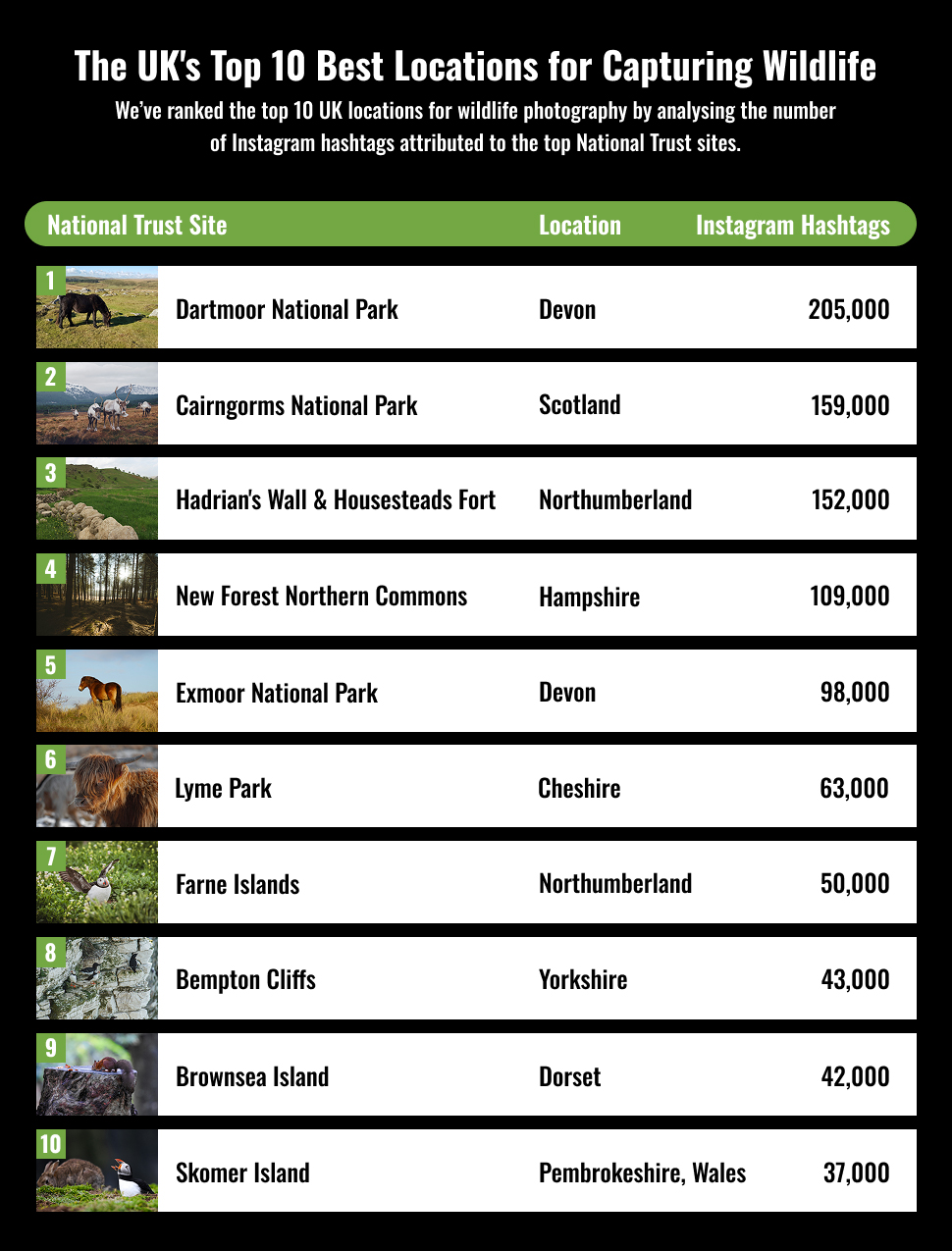
1. Dartmoor, Devon — 205K hashtags
Dartmoor is the top UK location for wildlife according to our data. Covering 954 square kilometres, Dartmoor National Park is the largest upland area in southern Britain, and its rugged granite tors, heather moorland, and sheltered valleys create the perfect mix of habitats for a huge variety of species.
What makes Dartmoor so special is its untouched feel. Centuries of low-intensity farming have allowed rare plants, insects, and birds to thrive. You can spot everything from butterflies flitting between wildflowers to moorland birds like skylarks and meadow pipits taking to the skies. Keep an eye out for Dartmoor ponies too! They look wonderful when photographed against the dramatic landscape.

Lizzie says: "The weather on Dartmoor can switch in an instant. Thankfully, most modern cameras are moisture-resistant and splash-proof. But for really wet conditions, pack waterproof accessories, like a rain cover for your camera or lens, and keep a small towel handy to wipe off any stray droplets."
"A good telephoto lens will help you capture shy species from a distance without disturbing them. And don't forget your macro lens if you want to get those incredible close-ups of lichens and insects."
Read our Macro Photography Guide to learn more.
2. Cairngorms National Park, Scotland — 159K hashtags
If you're a fan of cats, Cairngorms National Park in Scotland is the place to be. It's home to some of the UK's rarest and most remarkable wildlife, including the critically endangered Scottish wildcat. Thanks to the Saving Wildcats project, captive-bred wildcats have recently been released into the Cairngorms National Park, giving photographers an incredible (but very rare!) chance to capture this iconic predator in its natural habitat.
To increase your chances, focus on woodland areas, moorland, and forest edges, particularly around dusk and dawn when these secretive cats are more active. Just be sure to stick to marked paths, and always respect the wildlife and their habitat.

But don't worry if you don't spot a wildcat — there's plenty more to see here. Red squirrels, golden eagles, pine martens, and even rutting deer roam these ancient forests and mountains.
Britain’s only free-ranging herd of reindeer also wanders the high mountain plateaus of the Cairngorms, where you might spot them grazing in the snow — a truly magical sight for any wildlife photographer.
With nine National Nature Reserves across the park, there are plenty of safe, protected spots to watch wildlife up close. Just bring your longest lens and a good dose of patience.
3. Hadrian's Wall and Housesteads Fort, Northumberland — 152K hashtags
For history and wildlife in one trip, it doesn’t get much better than Hadrian’s Wall. Stretching for 80 miles through Northumberland’s rolling green countryside, this ancient Roman landmark isn’t just an impressive sight; it’s also a surprisingly lively spot for wildlife photography.
The fields and sheltered spots along the Wall are a haven for birds like house martins, wheatears, and meadow pipits. Keep an eye out in the summer months for swooping swallows too — they make the long journey back from Africa each year. It’s also one of the few places you might catch a glimpse of the rare large heath butterfly, flitting through damp grassland, or the delicate orange tip butterfly dancing among wildflowers.

4. New Forest Northern Commons, Hampshire — 109K hashtags
The New Forest Northern Commons is a paradise for wildlife lovers. It’s home to a unique mix of habitats you’d struggle to find anywhere else in Western Europe, including ancient woodlands and wet or dry heathlands, hidden bogs, and even stretches of coastline. This patchwork landscape supports an incredible range of wildlife, from colourful dragonflies darting over mires to deer grazing beneath old oaks, plus plenty of woodland birds and reptiles to photograph along the way.
If you’re visiting in spring or summer, stick to the main tracks — especially if you're with a dog — to help ground-nesting birds rear their young safely. It’s the best way to protect this special place and enjoy capturing its wild residents at their best.

5. Exmoor National Park, Devon — 98K hashtags
Making it into the top five, Exmoor National Park is a real treat for wildlife photographers. This wild and beautiful landscape is best known for its iconic Exmoor ponies — a favourite subject for visitors with a camera in hand — but there’s so much more to capture here too.
Keep your eyes peeled for the UK’s largest herd of red deer roaming the moorland, as well as an incredible mix of butterflies, woodland birds, bats, and rare plants thriving in the park’s diverse habitats.

6. Lyme Park, Cheshire — 63K hashtags
With sweeping moorland, ancient woods, and open grasslands, Lyme Park is a brilliant spot for wildlife photography in North West England. The park’s famous red deer herd is always a highlight, especially during the autumn rut, when stags compete for mates. Just be sure to keep your distance and respect their space. “A good telephoto lens, like a 200–600mm, is perfect for capturing these moments safely,” explains Lizzie. “You can stay well back but still zoom right in for detailed shots, all without disturbing the deer.”
You can also expect to see Highland cows, too; their shaggy coats and sweeping horns make them wonderfully photogenic against the moorland backdrop.

Scattered across the estate are ancient trees. Some, like the oldest oak, are thought to be around 550 years old. They’re vital for wildlife, supporting hundreds of species of insects, birds, and fungi, so they’re well worth a closer look (and a few close-up shots!).
Autumn is a beautiful time to shoot here. Rich golden light, misty mornings, and changing colours add extra magic to every frame. To learn how to get the perfect shot, check out our Autumn Photography Tips and Ideas.
7. Farne Islands, Northumberland — 50K hashtags
Just off the Northumberland coast, the Farne Islands are a seabird paradise and a must-visit for any wildlife photographer. From around April to August, these rocky islands burst to life with thousands of breeding puffins. Their colourful bills and comical waddle make them a perfect subject for phototgaphy.
Lizzie says: "On the Farne Islands, you'll often be close enough on paths or boardwalks to get great puffin shots. Just stay on the paths and give them space, especially during breeding season."
"To get a more natural angle, crouch or sit so your camera is at puffin eye-level rather than shooting down. And use a long telephoto lens (around 300–600mm) to zoom in for detailed shots without getting too close and disturbing them."

Look out too for guillemots, Arctic terns, razorbills and huge grey seal colonies, especially in Autumn when pups appear on the shores.
8. Bempton Cliffs, Yorkshire — 43K hashtags
Another seabird hotspot is Bempton Cliffs in Yorkshire. Between March and August, these towering chalk cliffs become home to around half a million seabirds, making it the biggest seabird colony in England. Expect to see puffins, gannets soaring, and kittiwakes and guillemots nesting along every ledge.
It's not just the cliffs that are alive with activity, either. The grasslands above the sea bustle with skylarks, linnets, and corn buntings during the warmer months, while kestrels and barn owls can often be seen hunting.

Come winter, you might even catch sight of short-eared owls drifting low over the fields. It's a great chance to test your fast shutter speed and freeze the action!
9. Brownsea Island, Dorset — 42K hashtags
Tucked away in the heart of Poole Harbour, Brownsea Island is one of Dorset’s top spots for wildlife photography. Managed by the Dorset Wildlife Trust and the National Trust, it’s an internationally important haven for birds and other wildlife.
The island’s lagoon, reedbeds, and woodlands attract everything from wading birds and wildfowl to rare red squirrels. The Lookout wildlife observatory and bird hides make it easy to get great views without disturbing the animals.

10.Skomer Island, Pembrokeshire, Wales — 37K hashtags
A true gem for wildlife photography in Wales, Skomer Island is famous for its thriving seabird colonies. Just a short boat trip from the Pembrokeshire coast, this island bursts to life each spring and summer with huge numbers of puffins, guillemots, razorbills, kittiwakes, and the largest colony of Manx shearwaters anywhere in the world.
For photographers, the stars of the show are often the puffins, and you'll find them on the island from mid-April to late July. Guillemots and razorbills crowd the cliffs, while fulmars glide overhead.
Whether you visit for the day or stay overnight, you're guaranteed countless chances to fill your memory card with spectacular coastal shots.

Wildlife photography tips for capturing the perfect shot
Choose the right camera
"When it comes to wildlife, having the right kit makes all the difference," explains Lizzie. "If you're looking for the best camera for wildlife photography, go for one with fast autofocus and a good burst mode — that way you'll never miss a moment when an animal suddenly moves."
Lizzie adds: "For an all-in-one solution, the Nikon P1000 is a versatile bridge (superzoom) camera. The 125x optical zoom lens, equivalent to 24–3000mm, is absolutely perfect for wildlife by allowing you to keep well back and observe."
"The Nikon Z8 is also a fantastic choice. With 20fps continuous shooting, pre-burst capture, 45MP and 8K video, it's incredible for wildlife photography. The camera is super fast, essentially, so you won't miss the moment."
Bring a versatile telephoto lens
Lizzie says: "A quality telephoto lens lets you capture sharp, detailed shots from a safe distance without disturbing your subject. A zoom lens in the 300–600mm range is ideal for birds, deer, or shy animals that don't let you get too close."
"When you want to set the scene or show the habitat around your subject, the Sigma 70–200mm F2.8 is a brilliant choice," she suggests. "It's got a nice wide aperture for challenging light conditions and gives lovely bokeh too."
She adds: "The Sigma 150–600mm is also a fantastic option. It's got great reach, super sharp results, and it's surprisingly compact for what it offers. Plus, it comes with a more affordable price tag."
"However, if you prefer photographing insects or flowers up close, pack a macro lens too. You'll be rewarded with crisp, detailed shots."
"If you're carrying your kit all day, consider the weight and balance too. Sometimes a lighter lens can make a long day much more comfortable."
Use a fast shutter speed for moving animals
"Fast-moving animals, especially birds in flight or deer on the run, can really test your camera skills," says Lizzie. "A fast shutter speed, like 1/1000s, will help freeze the action and keep your images crisp.”
"Just remember, the faster your shutter speed, the less light hits the sensor, so you'll often need to open up your aperture or raise your ISO to get a well-exposed shot. It's all part of balancing the exposure triangle."
"Using a tripod or monopod is also really helpful when shooting with fast shutter speeds, as it keeps your camera steady and avoids unwanted blur."
To learn more, read our guide on What is Shutter Speed?

Research the species you want to photograph
"Before you head out, spend time researching your location and the wildlife you hope to see," suggests Lizzie. "Find out where animals feed, rest, or breed, and learn when they're most active (dawn and dusk are often the best times!)"
"Be patient and allow animals to come to you rather than chasing them; not only will you capture more natural behaviour, but you'll also help keep them safe and relaxed."

How to stay respectful as a wildlife photographer
Prioritise the animal's welfare
Lizzie says: “Putting the animal’s welfare first should always be your top priority. Try to observe from a distance and use a good telephoto lens so you don’t need to get too close. That way, you’re capturing wildlife behaving naturally, not reacting to you. It’s really important not to interfere: don’t feed, touch, or try to lure animals in for a shot. Just let them do their thing."
"If you come across nests, dens or young animals, give them plenty of space and avoid hanging around too long. Learning to read an animal’s body language is a skill worth having. If you see signs of stress, like fidgeting or an attempt to move away, take the hint and retreat. In the end, you’ll get far better shots if the animal feels safe and undisturbed.”
Respect the environment
"Respecting the environment goes hand-in-hand with photographing wildlife responsibly," suggests Lizzie. "Always follow local rules and guidelines. For example, on the Farne Islands, you must stick to the designated boardwalks to protect the sensitive puffin burrows and nesting sites close to the paths. It's always worth checking local guidelines before you go, and many places have information centres. Don't be afraid to ask if you're not sure what's allowed!"
"You should also pack up all your litter and take care not to damage plants or habitats as you move around."
Keep group sizes small
"If you're heading out to photograph wildlife, try to go alone or in a small group," says Lizzie. "Large groups can be noisy without meaning to be, and more movement can easily spook wildlife."
"Fewer people mean less disturbance, and you'll often have a much better chance of seeing animals behaving naturally. Plus, it's easier to stick to paths because you're not trying to spread out to get a better view."
Time your visits carefully
Lizzie recommends: “It’s worth thinking about when you go, not just where. Early mornings and late evenings are often the best times to see wildlife, but they’re also when animals are feeding or looking after young. So always take extra care not to disturb them during these sensitive times, especially in spring and early summer when lots of species are breeding."
Capture stunning wildlife images on your next trip with Jessops
If you're looking for inspiration and the chance to get up close with amazing subjects, our Wildlife Photography Experiences are the perfect place to start. We offer different options — like our British Wildlife Experience or Birds of Prey Experience — each giving you the chance to capture stunning shots in a natural setting, with expert guidance to suit all skill levels.
And when you're ready to head out into the wild on your own adventure, Jessops has everything you need, from the latest digital cameras and lenses to tripods, camera bags, and handy accessories.
Just getting started with photography? Read our Beginner's Guide to Digital Cameras. Or for more advice and inspiration, check out our blog. If you have any questions or you're unsure about which product is right for you, contact us today.
Sign up for our latest news and offers
Receive the best offers right to your inbox by signing up to our newsletter
Thank You
